
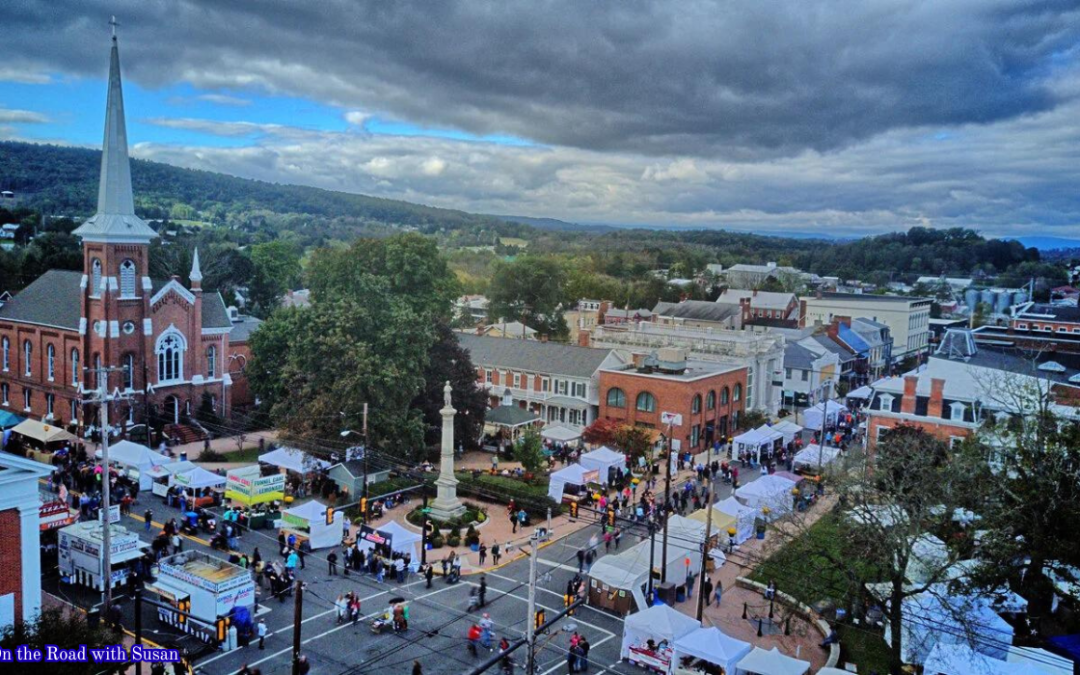
A Frontier Fort, A President's Summer Retreat, Covered Bridges
And one very famous coffee Pot.
Two days is all it takes to fall for this Allegheny mountain small town.
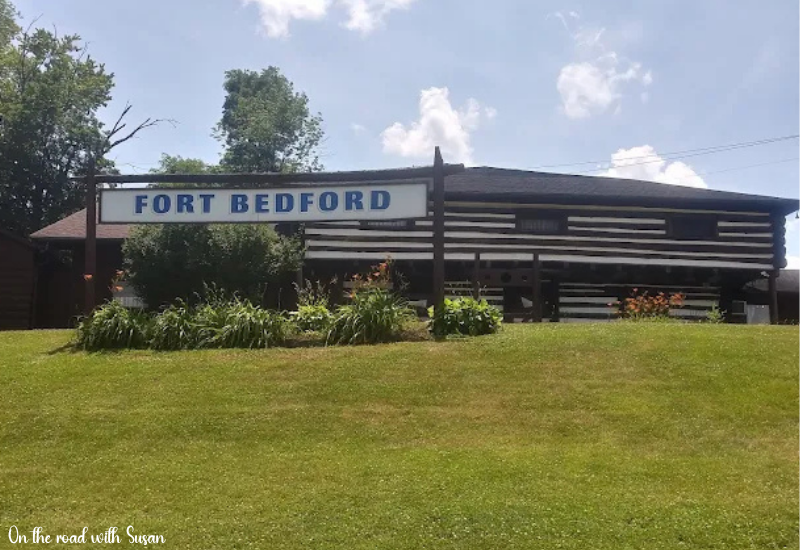
A Fort Called Bedford
Bedford’s story doesn’t begin with a town at all. It begins with a trading post. Around 1750, a trader named John Wray set up shop along a stream in the Allegheny foothills, and the little cluster of buildings that grew up around him took the name Raystown. It was a frontier crossroads before it was anything else — a place where Native trails, mostly used for centuries by the Shawnee and other regional nations, converged along the Raystown Branch of the Juniata River.
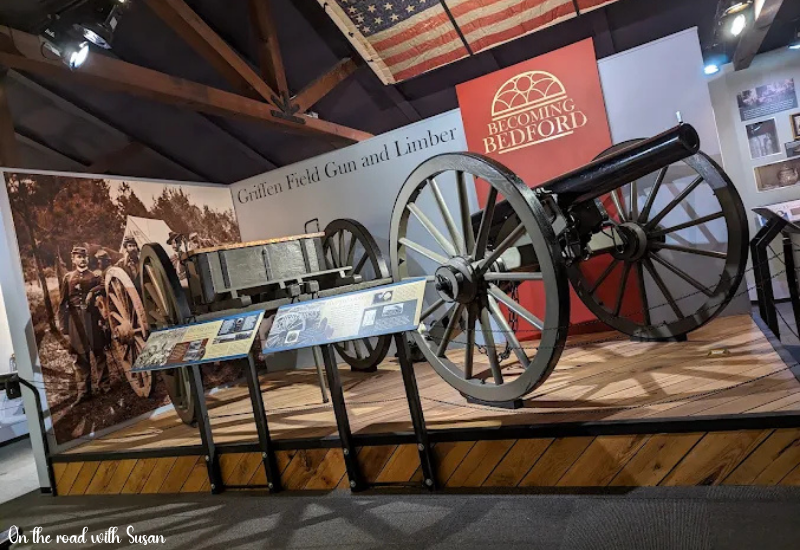
The French and Indian War changed everything. In 1758, British General John Forbes chose Raystown as the site for a fort and supply depot to support his campaign against Fort Duquesne, the French stronghold at the forks of the Ohio River — modern-day Pittsburgh. The outpost was first called Fort Raystown, then renamed Fort Bedford in honor of the Duke of Bedford, a powerful figure in the British government of the day. That name stuck to the settlement that grew up in its shadow, and it’s the name the town carries still.
Standing on History
The original fort is long gone, but a reconstruction stands today as the Fort Bedford Museum, overlooking the Raystown Branch from the same bluff the British chose in 1758. It’s the easiest way to picture what this whole valley looked like when it was the edge of the known world.
The town of Bedford was formally laid out in 1766 and incorporated as a borough in 1795, and it wasn’t just a military footnote. In 1794, President George Washington himself passed through, personally inspecting troops mustered to put down the Whiskey Rebellion — the young nation’s first real test of federal authority. He stayed at what’s now known as the Espy House, still standing on Pitt Street, making Bedford one of the few small Pennsylvania towns that can say a sitting president bunked there before the country had even turned twenty.
“Bedford’s development was further enhanced by the construction of key infrastructure, particularly roads that connected the town to other areas of Pennsylvania.”
On Bedford’s early growth as a trade and travel crossroads
By 1771, Bedford had become important enough to anchor its own county — one so large at the time that it originally stretched across nearly a third of Pennsylvania, encompassing land that would eventually be carved into Huntingdon, Blair, Cambria, Somerset, Fulton, and Bedford counties as we know them today. The Bedford County Courthouse, built on the town square, remains one of the oldest county courthouses in continuous use in the entire state.
The Springs That Became a President's Retreat
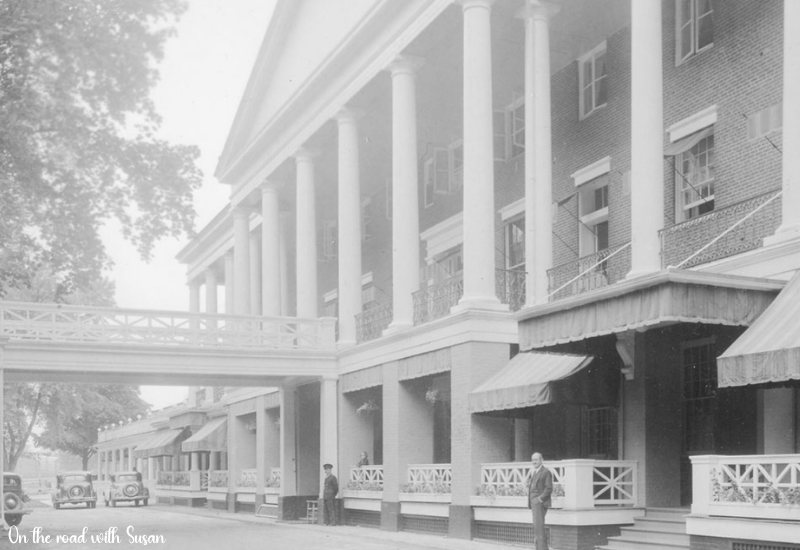
Omni Bedford Springs Resort
Just a couple of miles south of downtown, mineral springs bubbling up out of the Allegheny foothills would end up putting Bedford on the national map in a completely different way. What began in the 1790s as a modest bathhouse over those springs grew, over the following century, into one of the great American resort hotels — the kind of place where the country’s most powerful people came to “take the waters” and, not incidentally, to conduct the nation’s business somewhere quieter than Washington.
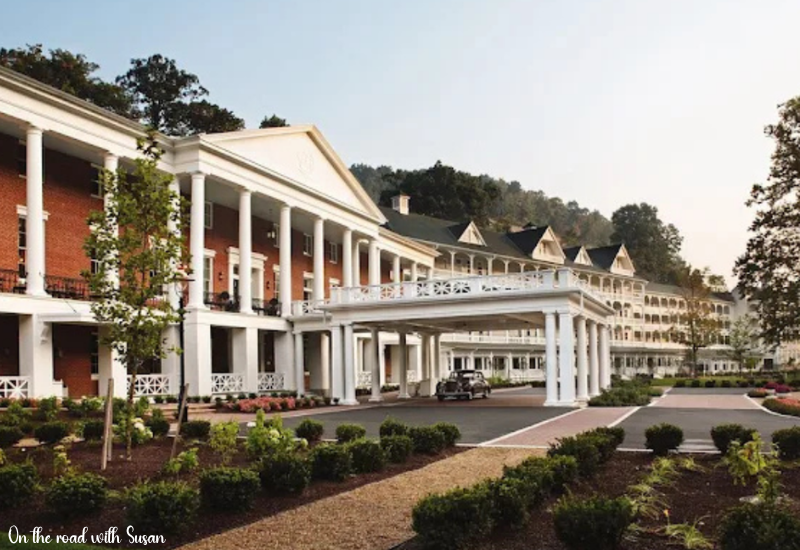
Today it’s known as the Omni Bedford Springs Resort, and parts of the current building date back to 1796, with the grand Georgian-style hotel taking its recognizable shape through the 1800s. President James Buchanan used Bedford Springs as his own summer White House in the years leading up to the Civil War, reportedly signing the first transatlantic telegraph cable message from the property in 1858. The guest list over the decades read like a survey of American power — presidents, industrialists, and statesmen who came for the reputedly restorative mineral waters and stayed for the mountain air.
Still Standing, Still Grand
The resort fell quiet for stretches of the 20th century, but a major restoration reopened it in 2007, reclaiming the original Georgian exteriors, restoring one of the country’s first indoor swimming pools — built directly over a natural spring — and refurbishing an 1895 golf course that ranks among the earliest formally designed courses in the United States. It’s a National Historic Landmark today, and you can still walk the same colonnaded porches Buchanan once did.
Want the fuller story? Read more about the History of this Historical Hotel for more on Bedford Springs and the other grand old properties still welcoming guests across the state.
What makes Bedford Springs worth the detour isn’t just the history — it’s that you can still experience it the way guests did a century and a half ago. The spa still draws on those same mineral springs. The golf course is still played. Afternoon tea is still served. It’s a rare thing: a genuine 18th-century resort that never became a museum piece, because it never stopped being a working hotel.
Main Street, U.S.A. — Literally
If Bedford’s first act was as a military crossroads, its second act was as a highway town. U.S. Route 30 runs directly through the heart of Bedford, and Route 30 is the Lincoln Highway — America’s first road conceived to run coast to coast, from Times Square in New York to Lincoln Park in San Francisco. Before the Pennsylvania Turnpike opened in 1940 and pulled the through-traffic south onto a controlled-access route, the Lincoln Highway through Bedford was the main east-west artery connecting Philadelphia to the Midwest — and Bedford’s downtown grew up shaped by that traffic.
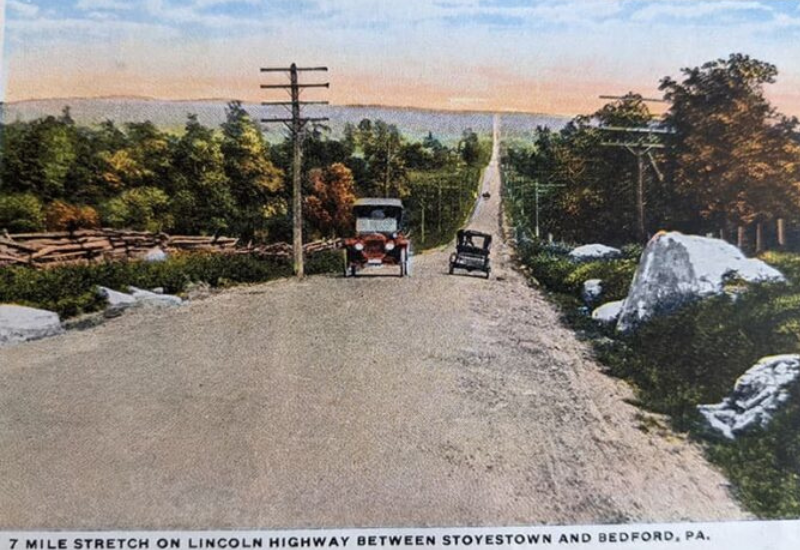
The Lincoln Highway didn’t just pass Bedford by — it built parts of it. Diners, motor courts, and gas stations sprang up along Route 30 through the 1920s and ’30s to catch travelers making the slow, winding drive across the Alleghenies, back when a trip from Philadelphia to Pittsburgh could eat up the better part of a day. Some of that roadside architecture still survives, which is part of what makes a drive through Bedford County feel like time travel with a steering wheel.
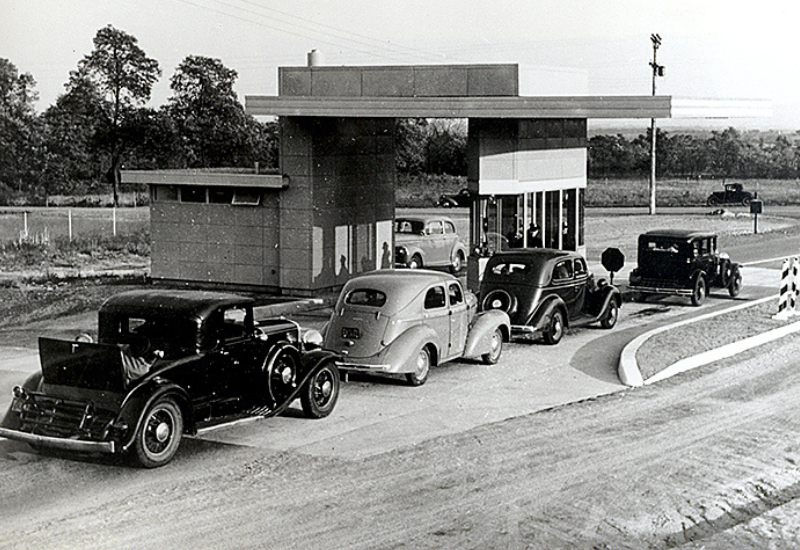
Up until the Pennsylvania Turnpike opened in 1940, U.S. Route 30 through Bedford was the key east-west route connecting Philadelphia to the west.
Bedford Borough, on the town’s highway-era importance
If You’ve Read My Lincoln Highway Series
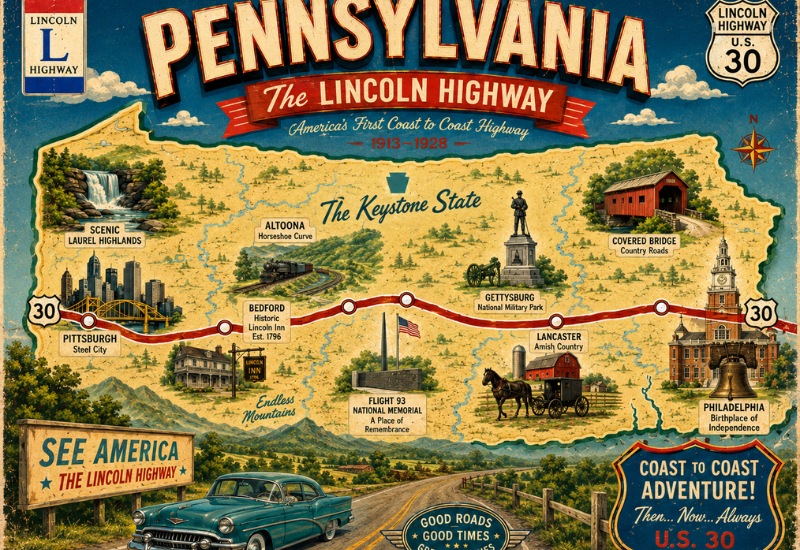
Bedford County sits right in the thick of the Pennsylvania leg — the same stretch that carried me past Gettysburg, the Flight 93 Memorial, and the giant Coffee Pot. If you followed along, consider this post the deep-dive detour I owe this particular stretch of road.
Sleep Where the Lincoln Highway Slept
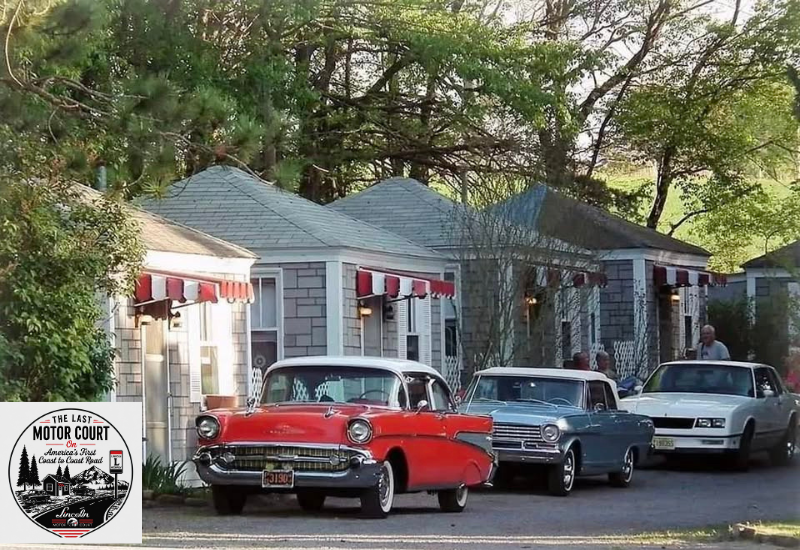
A few miles west of downtown in Manns Choice sits the Lincoln Motor Court, the last surviving operating motor court on the entire Lincoln Highway. Built in the 1940s to house travelers making the long haul across the Alleghenies, it’s still welcoming overnight guests today in its original cabins — a rare, honest-to-goodness time capsule of the golden age of the American road trip. Click here to read my full blog on the history of the Lincoln Motor Court.
Roadside Icons Worth the Brake Check
This is Lincoln Highway roadside-Americana country, and Bedford County holds onto more of that original character than almost anywhere else on the eastern half of the route. A few stops that earn a full stop, not just a slow drive-by:
The Bedford Coffee Pot
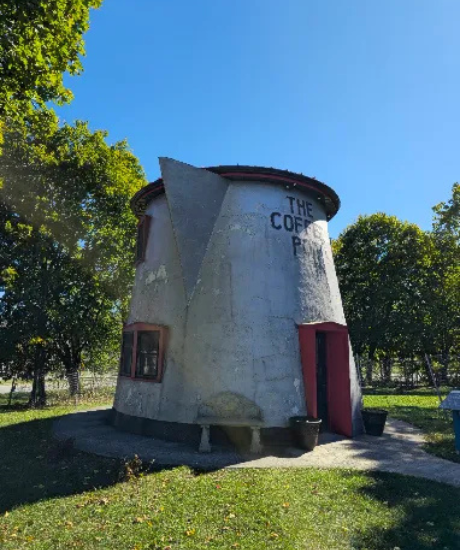
In 1927, David Koontz built a diner shaped like a giant coffee pot right along the Lincoln Highway — a piece of pure early roadside advertising, built to catch the eye of drivers doing 35 miles an hour. It sold sandwiches and coffee to Route 30 travelers for decades. The Coffee Pot was moved in 2003 to the Bedford County Fairgrounds, where it still stands today as one of the most photographed pieces of Lincoln Highway kitsch in the entire country.
Old Bedford Village
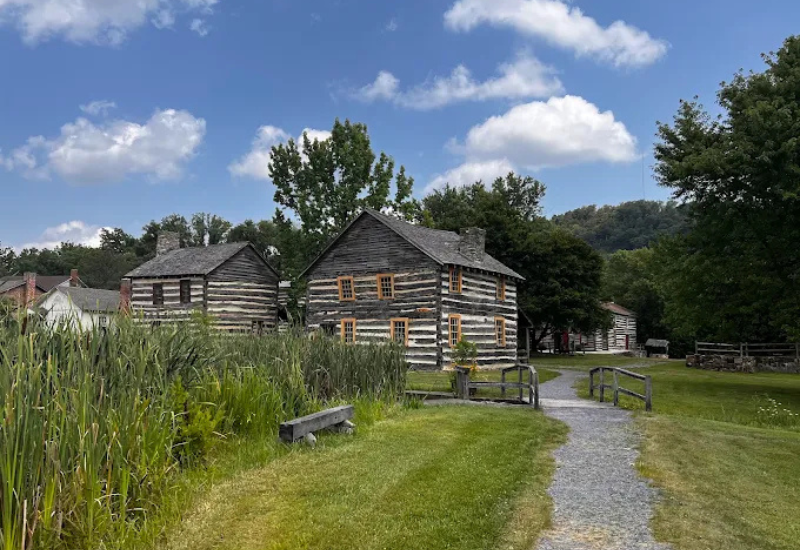
A living-history village assembled from more than 40 historic log, stone, and frame buildings gathered from around the county, arranged to recreate frontier and 19th-century Bedford life — complete with costumed interpreters, working artisans, and seasonal events. It sits at the entrance to the covered bridge driving tour, which makes it a natural first or last stop.
National Museum of the American Coverlet
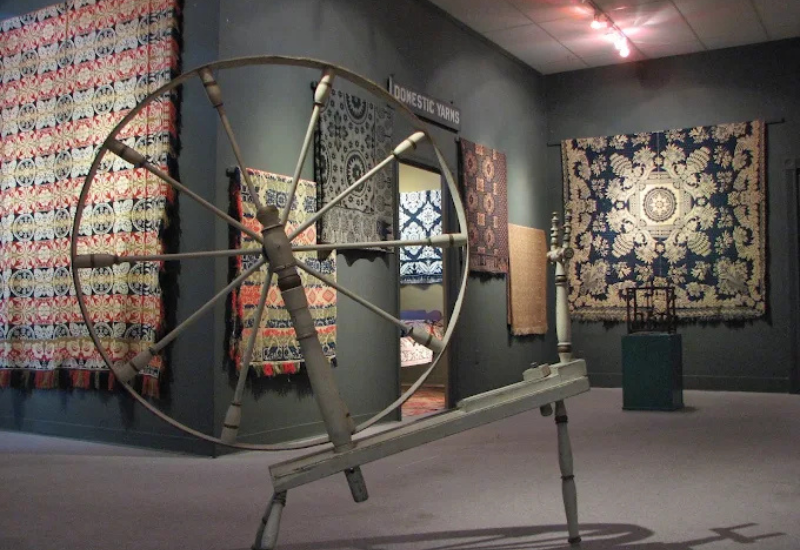
Housed in a former 1859 elementary school, this small but genuinely unique museum celebrates the region’s woven coverlet tradition — a craft that flourished across rural Pennsylvania in the 19th century and rarely gets a museum of its own anywhere else in the country.
Fourteen Historical Covered Bridges, One County
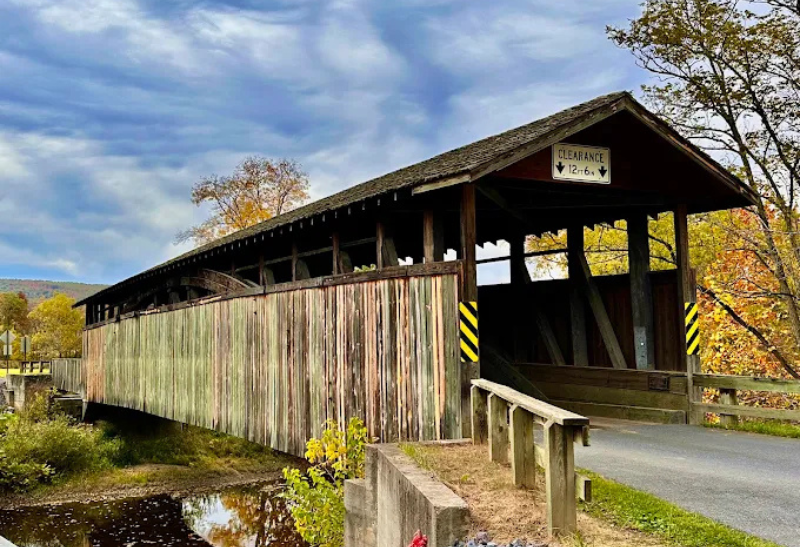
Here’s the number that surprises people: Bedford County has fourteen historic covered bridges, one of the largest concentrations left in Pennsylvania — nearly all of them still standing where they were built roughly a century ago, and several still carrying traffic across the creeks and rivers they were designed for. Twelve are Burr-truss bridges, a design patented by 19th-century engineer Theodore Burr that uses an arch working in tandem with a truss system for extra strength, which is a large part of why so many of these structures have survived as long as they have.
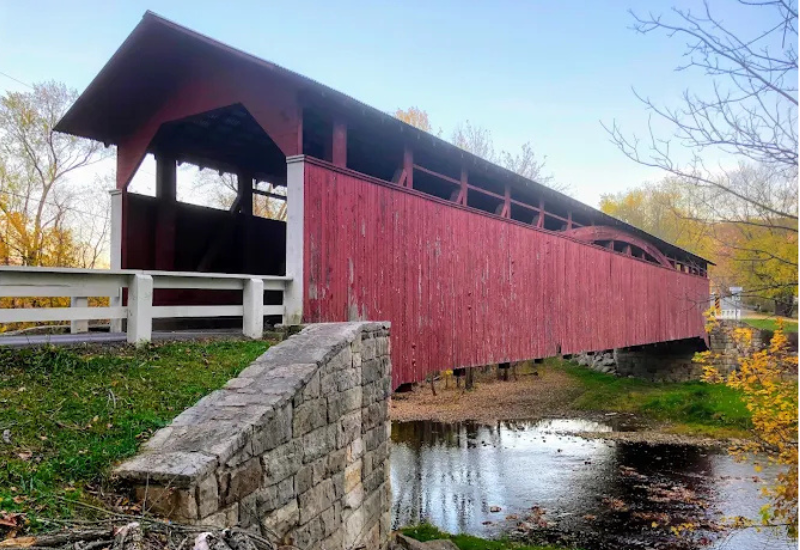
The Bedford County Visitors Bureau maps out a self-guided driving tour that hits nine of the fourteen bridges in roughly 40 miles and about 90 minutes of driving time — though nearly everyone I’ve read who’s done it says to budget closer to three or four hours once you factor in getting out of the car at every single one, which you will absolutely want to do. The tour traditionally starts at Old Bedford Village, where the Claycomb Covered Bridge greets you at the entrance, and winds northwest through farmland and small crossroads towns like Schellsburg and New Paris.
- Claycomb Covered Bridge 1880 · Bedford · Entrance to Old Bedford Village
- Herline Covered Bridge 1902 · Manns Choice · Longest in the county, 136 ft
- Bowser (Osterburg) Covered Bridge 1890 · Osterburg · Bypassed, pedestrian only
- Colvin Covered Bridge 1894 · Schellsburg · Crosses Shawnee Creek
- Dr. Knisely Covered Bridge 1880s · Pleasantville · Crosses Dunning Creek
- Cuppett’s Covered Bridge 1882 · New Paris · Near Gravity Hill
- Snooks Covered Bridge 1883 · Alum Bank · Open to vehicles
- Fichtner (Palo Alto) Covered Bridge 1880 · South of Hyndman · Shortest, 56 ft
Watch: My Weekend Getaway to Bedford, PA.
My Final Thoughts
What I love most about Bedford is that it never really had to reinvent itself. It was a crossroads for the Shawnee and Iroquois long before it was a fort, a fort before it was a town, a spa town before it was a highway town, and a highway town before it became the kind of place road-trippers like us seek out on purpose. Every era just layered on top of the last one instead of erasing it — which is exactly why you can still have afternoon tea where a president once summered, drive across a bridge built when Theodore Roosevelt was in office, and photograph a coffee pot that’s been famous since your great-grandparents’ generation, all in the same single day.
If you only have a weekend, give Bedford a full one. Walk the historic downtown, sit with the fort’s story at the museum, treat yourself to a night at the Springs, and then spend a slow morning chasing covered bridges down back roads with the windows cracked. That’s the whole formula for the kind of trip this blog exists to talk you into — and Bedford delivers it better than almost anywhere else in Pennsylvania.
Until next time!
Susan