


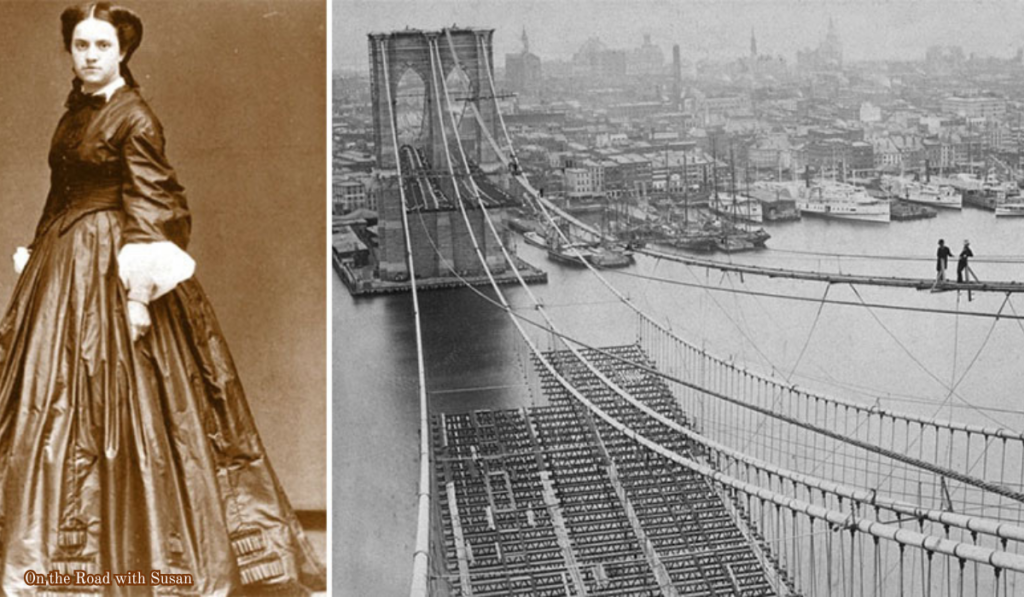
The engineer's wife who became the Brooklyn Bridge's true chief engineer
She never held the title. For eleven years, she did the job anyway — walking the caissons, running the stress calculations, and answering to a Board of Trustees that never fully realized who was actually in charge.

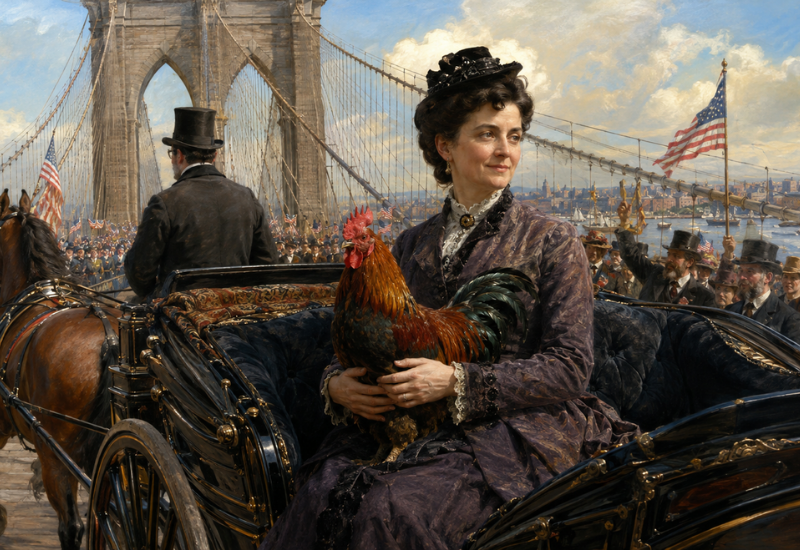
On May 24, 1883, a carriage rolled across the newly finished Brooklyn Bridge carrying a live rooster in its owner’s lap — an old builder’s symbol of victory. The woman holding that rooster was not the bridge’s chief engineer, at least not on paper. But everyone who had worked the towers, the anchorages, and the cables over the previous decade knew exactly whose bridge this was. Her name was Emily Warren Roebling, and without her, the Brooklyn Bridge very likely does not get built at all.
A Warren of Cold Spring 1843–1864
Emily Warren was born September 23, 1843, in Cold Spring, New York, the second-youngest of twelve children in a well-established Putnam County family. Both of her parents died while she was still a teenager, and it was her much older brother, Gouverneur Kemble Warren, who took over shaping her education. Warren would go on to become a Union general, famous for his defense of Little Round Top at Gettysburg, and he pushed his younger sister toward science and mathematics at a time when neither subject was considered proper territory for a young woman.

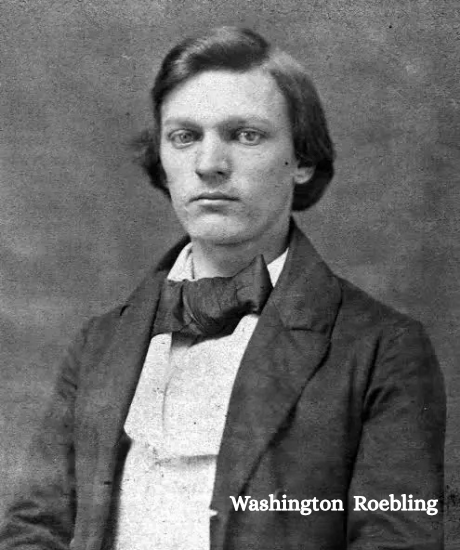
It was through her brother’s army connections that Emily met Washington Augustus Roebling, a young engineering officer serving on Warren’s staff. Washington was the son of John A. Roebling, the German-immigrant engineer already famous for pioneering wire-cable suspension bridges. Emily and Washington married in January 1865, and the marriage would eventually put her at the center of one of the most ambitious construction projects in American history.
Two Roeblings Fall 1867–1872
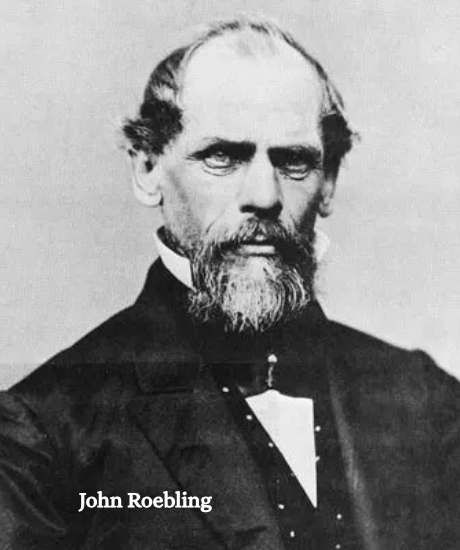
In 1867, John A. Roebling was hired as chief engineer for a bridge across the East River that would connect Brooklyn and Manhattan — a span longer than any suspension bridge yet attempted, resting on towers sunk into bedrock through massive timber caissons. Before construction had properly begun, John Roebling died of tetanus in 1869 after an injury sustained while surveying the site. His son Washington, only in his early thirties, inherited the chief engineer’s title and the full weight of the project.
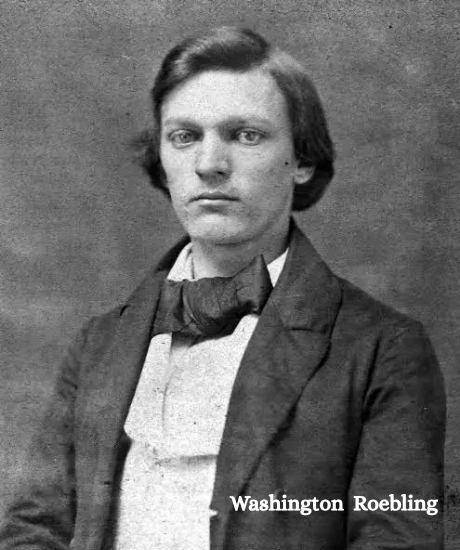
Washington had already traveled to Europe with Emily to study caisson technology firsthand, and he threw himself into the work of sinking the bridge’s twin towers. It was dangerous labor. Workers descended into pressurized wooden chambers beneath the riverbed to dig out bedrock, and many came up with a poorly understood affliction the papers called “caisson disease” — what we now know as decompression sickness. By 1872, Washington himself was among the worst-affected. He emerged from the caissons partially paralyzed, his eyesight and speech impaired, and largely confined to his home in Brooklyn Heights for the rest of the project.
A bridge with no functioning chief engineer, a Board of Trustees losing patience, and a construction site that could not simply pause — that was the situation Emily Roebling stepped into in 1872.
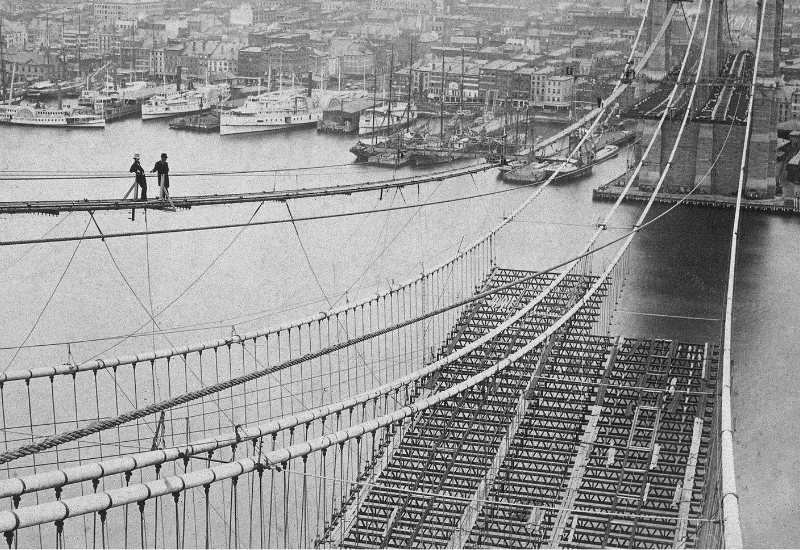
The Chief Engineer in Everything but Title 1872–1883
At first, Emily’s role was simple message-carrying: she relayed Washington’s instructions from his sickroom to the engineers and foremen on site. That could not last. The Brooklyn Bridge was one of the most technically demanding structures ever proposed in the United States, involving cable catenary calculations, wire-strand tensile strength, stress distribution across the towers, and the daily judgment calls that a live construction site throws off by the hour. Over the following decade, Emily taught herself the engineering behind all of it — higher mathematics, the strength of materials, catenary curves, cable construction — well enough to translate her husband’s technical direction into instructions the crews could execute, and well enough to make calls of her own when there was no time to wait for him.
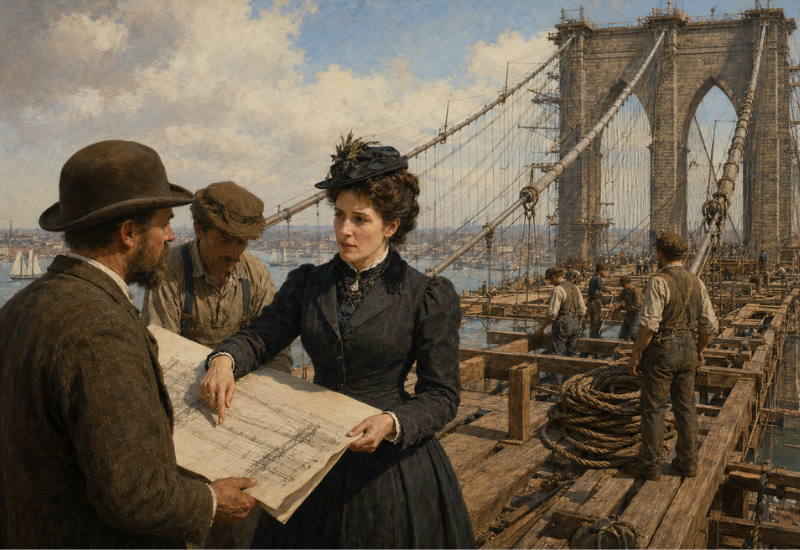
She spent long days on site, climbing the towers and inspecting the cable-spinning work herself. She corresponded directly with contractors and suppliers. When rumors began circulating that Washington was too incapacitated to continue, and a movement grew on the Board of Trustees to have him replaced, it was Emily who worked the politics of the project as skillfully as she worked its engineering — meeting with board members, answering questions about technical specifications in person, and defending her husband’s fitness to remain chief engineer. Many of the men she dealt with came away assuming they had been speaking with someone functioning as chief engineer in her own right, whatever the organizational chart said.
By the Numbers: What She Was Managing
The bridge’s four main cables each contain thousands of individual steel wires, spun in place high above the East River and bundled into cables roughly 15¾ inches in diameter. Calculating how those cables would bear the load of the roadway, streetcars, and their own enormous weight was not paperwork — it was the mathematics standing between a finished bridge and a catastrophic failure.
Crossing the Finished Bridge May 24, 1883
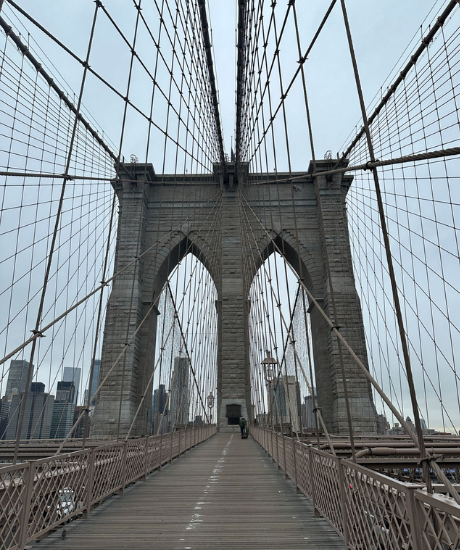
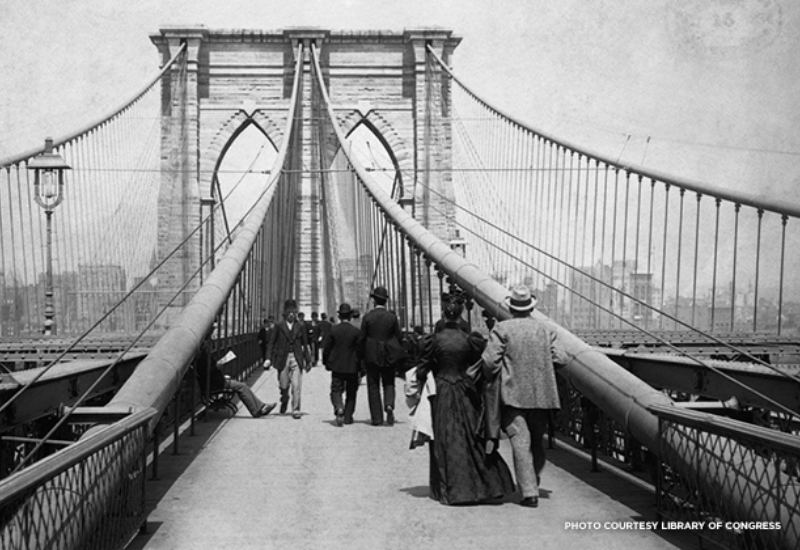
When the Brooklyn Bridge officially opened, Emily Warren Roebling was the first person to cross it, riding in a carriage with a rooster in her lap as an old symbol of triumph. At the dedication ceremony, speakers publicly credited her contribution to the bridge’s completion — a rare acknowledgment, for the era, of a woman’s engineering role in a major public work. Washington, still largely confined to his home, watched the opening-day celebrations from a window overlooking the bridge he had designed but could not walk across himself.
Beyond the Bridge 1883–1903
Roebling’s life after 1883 was not a quiet retirement. She became active in women’s organizations including the Daughters of the American Revolution, traveled widely in Europe, and was presented at the courts of Queen Victoria and later attended the coronation of Tsar Nicholas II in Russia. She pursued formal education seriously, earning a law certificate from New York University in 1899, and wrote on women’s legal rights, including an essay titled “A Wife’s Disabilities,” arguing for reform of the laws that limited married women’s legal standing — publishing it, tellingly, under her husband’s initials rather than her own name.
Emily Warren Roebling died in Trenton, New Jersey, on February 28, 1903, at age fifty-nine, and was buried in her hometown of Cold Spring, New York.
Why She Matters
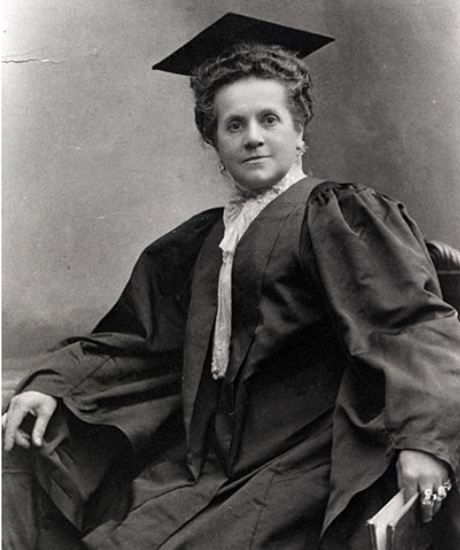
Historians of engineering now generally describe Emily Warren Roebling as the first woman to function as a field engineer on a major American construction project, more than half a century before women were formally welcomed into the profession. Her achievement sits at an uncomfortable intersection: she did work that, done by a man, would have carried the title of chief engineer, and she did it while the era’s professional and legal structures assumed no woman could. In May 2024, Rensselaer Polytechnic Institute — the alma mater of both her husband and her son — awarded her a posthumous honorary doctorate as part of the school’s bicentennial, a formal engineering credential arriving 121 years after her death.
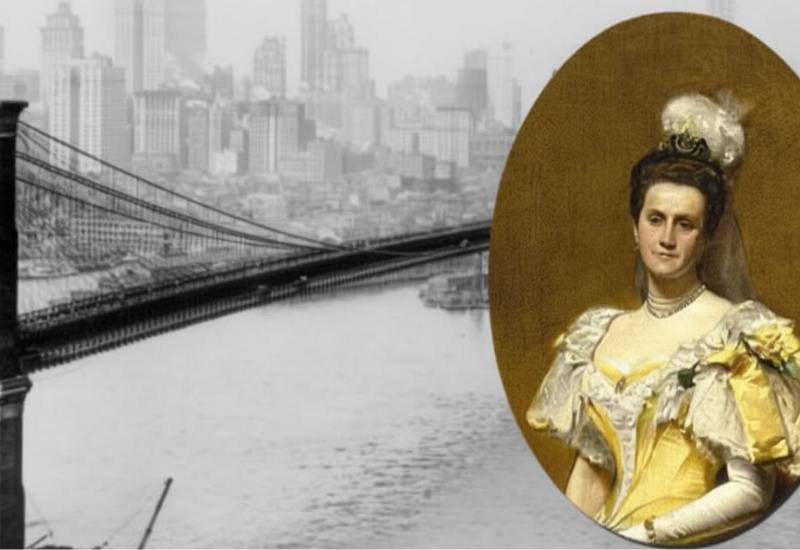
The bridge itself still carries her memory. A plaque at its Brooklyn approach honors all three Roeblings — John, Washington, and Emily — and a sculpture at the base of the bridge does the same. Every commuter, cyclist, and tourist who crosses the Brooklyn Bridge today is, in a very literal sense, walking across Emily Roebling’s calculations.
My Final Thoughts
What sticks with me most about Emily Roebling isn’t the rooster in her lap or even the honorary doctorate that finally caught up with her more than a century late. It’s the eleven years in between — the ones nobody applauded at the time, where she just kept showing up, kept doing the math, kept answering for a job she never got to call her own. History tends to hand us the ribbon-cutting and skip the decade of quiet, unglamorous competence that made the ribbon-cutting possible. Emily Roebling’s story is a good reminder to look for the person doing that work in our own time, too — the one holding a project together with no title to show for it.
I’ll admit I didn’t expect a Butler County backyard rope walk to be the real starting point of the Brooklyn Bridge until I started digging into this one. That’s the part of heritage travel I love most: the biggest stories are so often hiding behind the smallest markers. If this one sent you down a rabbit hole the way it did me, I hope you’ll get out and see some of these places for yourself.
You never know what interesting history you will uncover if you never take the time to stop and look.
Until Next Time!
Susan